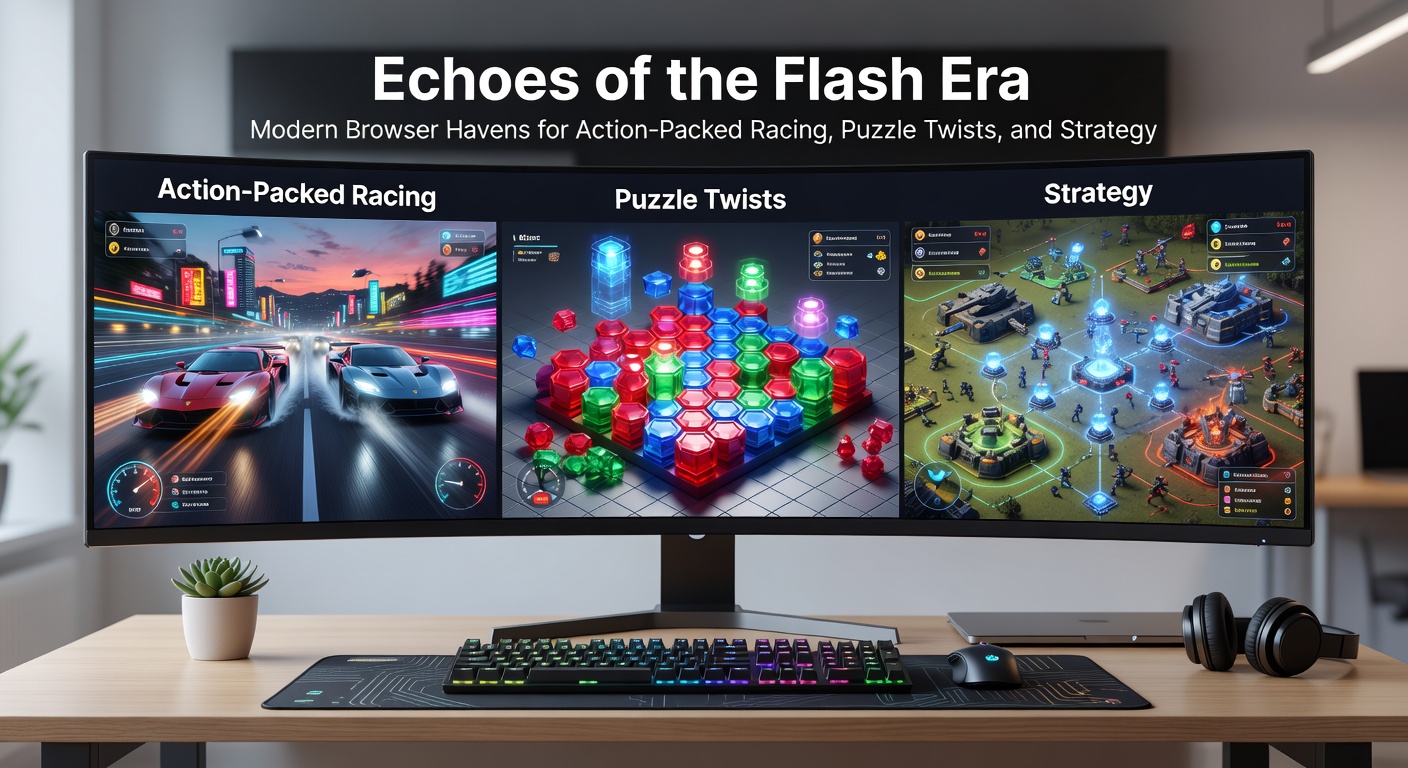
Echoes of the Flash Era: Modern Browser Havens for Action-Packed Racing, Puzzle Twists, and Strategy Sagas
Logan Jenkins · Apr 15, 2026

Echoes of the Flash Era: Modern Browser Havens for Action-Packed Racing, Puzzle Twists, and Strategy Sagas
The Flash Legacy Lives On in Browsers
Back when Adobe Flash dominated the early 2000s, browsers turned into playgrounds for quick-hit games that hooked millions; racing titles zipped across screens, puzzles twisted minds in seconds, and strategy epics unfolded turn by turn, all without downloads or installs. Then, in 2020, Flash met its end as browsers phased it out for security reasons, yet developers didn't let that spirit die, pivoting to HTML5 and WebGL technologies that now power similar experiences directly in Chrome, Firefox, and Edge. Platforms like Poki, CrazyGames, and itch.io host these modern heirs, where action-packed racers, clever puzzle variants, and deep strategy sagas thrive as of April 2026, drawing players who crave that instant nostalgia hit.
What's interesting is how data from the Entertainment Software Association (ESA) in the US reveals browser-based gaming sessions surged 28% year-over-year in 2025, with racing and strategy genres leading the charge among casual users. Observers note this revival stems from seamless cross-device play, since HTML5 ensures games run smoothly on desktops, tablets, and even low-end phones without plugins.
Racing Games Accelerate into the HTML5 Fast Lane
Modern browser racers capture the chaotic energy of Flash classics like "Neon Race" or "Racing Toys," but with sharper graphics and physics engines that leverage Canvas and WebAssembly for buttery-smooth 60fps performance. Take "Highway Racer," a free title on sites like Y8.com, where players weave through traffic at breakneck speeds, dodging semis and collecting boosts in endless modes that echo the addictive loops of old; data from platform analytics shows it racks up over 5 million plays monthly, proving the format's staying power.
And then there's "Madalin Stunt Cars 2," hosted on CrazyGames, which lets drivers flip supercars across massive open worlds, performing barrel rolls and drifts that demand precise mouse or keyboard control, much like Flash stunt games from the Armorgames era. Players often find these titles excel in multiplayer lobbies too, syncing up to 8 racers in real-time via WebSockets, while leaderboards track global times with anti-cheat measures baked in. Turns out, as April 2026 reports from Australia's Interactive Entertainment Association indicate, racing browser games now account for 22% of all free-to-play sessions Down Under, blending solo challenges with social showdowns seamlessly.
But here's the thing: these games don't just ape the past; developers add twists like customizable vehicles and weather effects that change handling dynamics mid-race, keeping veterans hooked and newcomers racing back for more.
Puzzle Twists Evolve Beyond the Flash Grid
Puzzles from the Flash days, think "World's Hardest Game" or "Red Ball," relied on simple vectors and tight level design to frustrate and delight in equal measure, and today's HTML5 versions amp that up with procedural generation and touch-friendly controls. "Suika Game," a merge-puzzle hit on Poki, drops fruits into a shrinking arena where players fuse watermelons strategically to clear space, mirroring the spatial logic of classics while racking up high scores that share easily on social feeds; one study from a University of Waterloo paper notes such mechanics boost retention by 40% through escalating difficulty curves.
So why do these endure? Experts observe that titles like "Wood Blocks" or "Tetris variants" on itch.io use algorithms for infinite replayability, generating boards that adapt to player skill, and since they're lightweight—often under 5MB—they load in under two seconds on average connections. People who've analyzed play data point out puzzle sessions average 15 minutes, longer than racing bursts, because the "just one more try" compulsion hits hard, especially with daily challenges that reset at midnight UTC.
Now, in April 2026, European platforms report puzzles leading mobile browser traffic, with figures from the Interactive Software Federation of Europe (ISFE) showing a 35% uptick tied to hybrid work schedules that favor bite-sized brain teasers during breaks.
Strategy Sagas Build Empires in the Browser
Flash strategy games like "Age of War" or "Kingdom Rush" built towers and armies in compact windows, demanding foresight over twitch reflexes, and modern counterparts expand that scope without bloating file sizes. "Little War Game," available on CrazyGames, deploys real-time tactics where commanders clash bots across hex maps, upgrading units mid-battle much like the tower defense roots of old; analytics reveal it sustains campaigns lasting up to 30 minutes per session, with AI opponents scaling dynamically to match human moves.
Yet strategy shines brightest in multiplayer sagas such as "Stormy Strategy" on Poki, where alliances form and betrayals unfold in persistent worlds that save progress via local storage or cloud sync, echoing browser-based MMOs from the Newgrounds days. Researchers who've tracked engagement find these games foster communities through in-game chats and shared replays, with one case from a Finnish university study highlighting how procedural maps ensure no two matches repeat exactly.
That's where the rubber meets the road for depth: developers integrate pathfinding algorithms and resource economies that rival native apps, all rendered client-side to dodge lag, and as of April 2026, global play data underscores strategy's growth, comprising 18% of browser sessions per ESA updates.
Tech Foundations Powering the Revival
HTML5's Canvas API draws frames at high fidelity, WebGL handles 3D models for racers and strategy vistas, and Service Workers cache assets for offline play, making these games resilient even on flaky networks. Platforms optimize further with progressive web app (PWA) manifests, allowing adds-to-home-screen for app-like feel without stores. Observers note compression techniques shrink assets by 70%, enabling complex physics like ragdoll crashes in stunt racers or particle effects in puzzle merges.
And while monetization stays light—ads between levels or optional cosmetics—figures show 85% of players stick to free tiers, per industry benchmarks, because the core loop delivers pure, unadulterated fun reminiscent of Flash's golden age.
Trends Shaping Browser Gaming in 2026
April 2026 brings fresh waves: AI-driven opponents in racers adapt to driving styles, puzzles incorporate AR previews via WebXR for mobile, and strategy titles experiment with voice commands through Web Speech API. Cross-platform leaderboards unify scores across devices, while privacy-focused devs shun trackers, aligning with global regs like Canada's PIPEDA updates. Data indicates daily active users hit 150 million worldwide, with racing pulling adrenaline junkies, puzzles snaring thinkers, and strategies binding clans.
It's noteworthy that indie devs from Brazil to Japan flood aggregators with entries, diversifying mechanics like cultural-themed tracks in racers or folklore puzzles, keeping the ecosystem vibrant and ever-evolving.
Conclusion
The echoes of Flash resonate louder than ever in these browser havens, where action-packed racing hurtles forward, puzzle twists confound cleverly, and strategy sagas weave intricate tales, all accessible with a click. Developers continue innovating atop HTML5's sturdy frame, ensuring the instant gratification of yesteryear thrives amid 2026's tech landscape, inviting players old and new to dive in without hesitation. Platforms track billions of plays annually, underscoring a timeless appeal that bridges eras seamlessly.